AI Agents in 2026: How Autonomous AI Is Changing the Way We Work
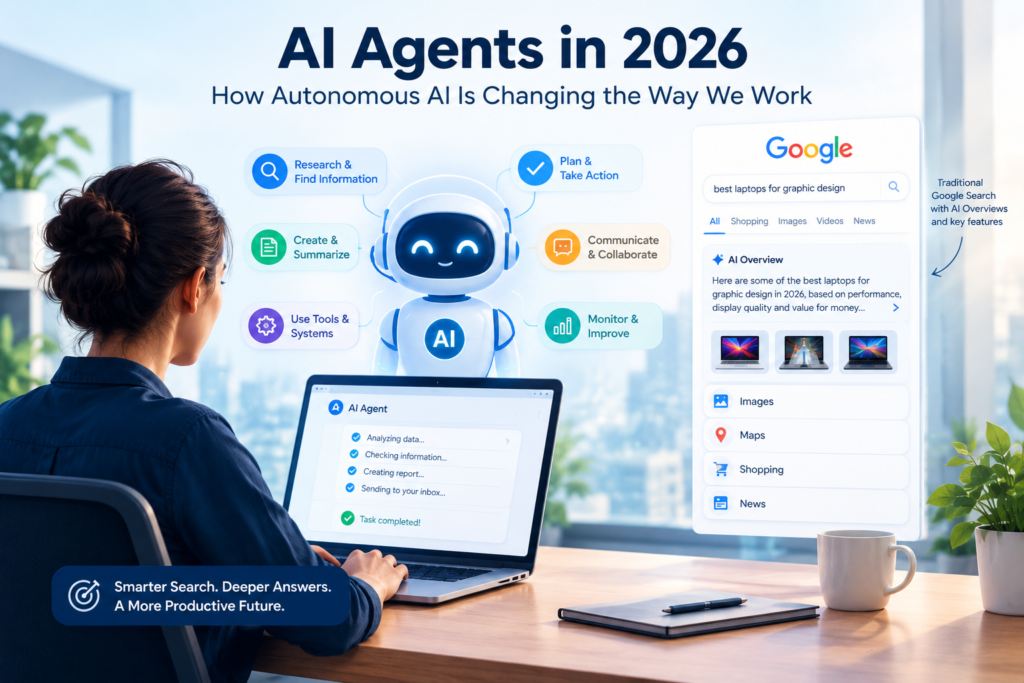
Artificial intelligence is moving beyond simply answering questions. In 2026, one of the biggest developments in AI is the rise of AI agents—systems designed to understand goals, use tools, complete multiple steps, and take actions with less human intervention.
Traditional AI assistants typically respond to a prompt. An AI agent can go further by planning a task, accessing approved tools or data, carrying out actions, checking results, and continuing until the assigned objective is completed or human input is required.
This shift from AI assistance to AI-driven execution is becoming increasingly important for businesses. OpenAI, Google, Oracle, SAP, and other technology companies are developing agent platforms and enterprise products designed to support more autonomous workflows.
But what exactly are AI agents, how do they work, and what can businesses realistically expect from them?
What Are AI Agents?
AI agents are software systems that use artificial intelligence to pursue a defined goal by reasoning through tasks, using tools, accessing information, and taking actions within approved boundaries.
Unlike a basic chatbot that waits for each instruction, an AI agent can be designed to handle a sequence of related actions.
For example, a traditional AI assistant might answer:
“How can I prepare a sales report?”
An AI agent could potentially:
- Retrieve approved sales data.
- Analyze performance.
- Identify significant changes.
- Create a report.
- Prepare a summary.
- Send the report to an approved recipient.
- Ask a human for approval before taking a sensitive action.
The exact capabilities depend on the agent’s model, tools, permissions, integrations, and safeguards.
AI Agents vs AI Assistants
The difference between an AI assistant and an AI agent is primarily about autonomy and action.
| Feature | AI Assistant | AI Agent |
|---|---|---|
| Responds to prompts | Yes | Yes |
| Understands natural language | Yes | Yes |
| Performs multi-step tasks | Limited or guided | Designed for multi-step execution |
| Uses external tools | Sometimes | Often |
| Makes plans | Limited | Common capability |
| Acts on systems | Usually limited | Can act within permissions |
| Runs workflows | Usually manually initiated | Can be scheduled or triggered |
| Human approval | Often required | Configurable depending on risk |
This distinction is not absolute. The term AI agent covers a broad range of systems, from relatively simple workflow agents to sophisticated autonomous systems.
How Do AI Agents Work?
AI agent technology typically combines an AI model with tools, instructions, context, memory, and an execution environment.
1. The Agent Receives a Goal
The process begins with an objective.
For example:
“Monitor incoming customer support requests and identify urgent cases.”
The agent needs enough context to understand what counts as urgent and what actions it is allowed to take.
2. The Agent Plans the Task
Instead of producing one immediate response, an agent may break the objective into smaller steps.
For a customer-support workflow, those steps could include:
- Read the incoming request.
- Identify the topic.
- Check customer information.
- Determine priority.
- Search approved knowledge sources.
- Draft a response.
- Escalate the request when necessary.
3. The Agent Uses Tools
This is one of the most important characteristics of autonomous AI agents.
An agent may connect to approved applications, databases, APIs, files, or business systems.
OpenAI’s Agents API, for example, is designed to support long-running agents that can use tools, work with files, run code, and coordinate subagents.
4. The Agent Takes Action
After reasoning through a task, the agent can perform an authorized action.
Depending on the system, this might include creating a document, updating a record, analyzing data, sending an approved message, or triggering another workflow.
5. The Agent Checks the Result
A more advanced agent can evaluate whether an action achieved the intended outcome and determine whether another step is necessary.
This creates a loop:
Goal → Plan → Act → Check → Adjust → Complete
The level of autonomy depends on how the agent has been designed and governed.
What Can AI Agents Do in 2026?
The most useful AI agent applications are generally connected to repetitive, multi-step workflows where information needs to be processed and actions need to be coordinated.
AI Agents for Business
Businesses can use AI agents for a wide range of workflows, including:
- Customer support
- Sales research
- Marketing operations
- Recruiting
- Software development
- IT operations
- Data analysis
- Document processing
- Internal knowledge management
- Scheduling and administrative tasks
Enterprise adoption is increasingly moving toward systems that can perform work rather than simply provide recommendations. Google describes its enterprise strategy around agents that can execute complex business workflows, while SAP is developing governance and process infrastructure for deploying AI agents at scale.
AI Agents for Software Development
Software development is one of the areas where agentic AI is developing particularly quickly.
An AI coding agent can potentially:
- Understand a software requirement.
- Inspect an existing codebase.
- Write or modify code.
- Run tests.
- Identify errors.
- Make corrections.
- Prepare changes for human review.
The important difference is that the agent can operate across multiple steps rather than simply generating an isolated code snippet.
AI Agents for Customer Service
Customer-service agents can help classify requests, retrieve information, draft responses, and escalate cases.
A well-designed system can allow an agent to handle routine requests while sending unusual or sensitive cases to human employees.
This model can make AI more useful without requiring organizations to give an agent unrestricted authority.
AI Agents for Research and Information Monitoring
AI agents can also monitor information sources for changes.
For example, an organization could use an agent to track:
- Industry developments
- Competitor announcements
- Regulatory updates
- Product changes
- Customer feedback
- Market information
Google announced information agents designed to monitor web information and provide synthesized updates based on a user’s interests and requirements.
Why Are AI Agents Becoming Important in 2026?
The rise of AI agents reflects a broader shift in how organizations think about artificial intelligence.
From Generating Content to Completing Work
Earlier generations of generative AI focused heavily on producing content.
Users asked AI to write an email, summarize a document, generate code, or create an image.
The next stage is increasingly about completing workflows.
An employee may no longer need to ask an AI system for every individual step. Instead, they can provide an objective and allow an agent to manage appropriate parts of the process.
The Goal Is Not Maximum Autonomy
More autonomy is not automatically better.
An agent that can take actions without sufficient controls can create operational, security, financial, or reputational risks.
The more authority an AI agent has, the more important it becomes to define:
- What the agent can access
- What actions it can perform
- What information it can use
- When human approval is required
- How actions are logged
- How mistakes are detected
- How access can be revoked
Recent enterprise AI developments increasingly emphasize governance, monitoring, permissions, and security alongside agent capabilities. HPE and NVIDIA, for example, have highlighted controls for autonomous agents that access data, use tools, write files, call APIs, and take actions across enterprise systems.
Benefits of AI Agents for Businesses
When implemented appropriately, AI automation can provide several potential benefits.
Increased Productivity
Agents can handle repetitive multi-step work, allowing employees to spend more time on activities that require judgment, creativity, communication, or strategic thinking.
Faster Workflow Execution
An agent can potentially perform several connected steps without waiting for a person to manually initiate each one.
24/7 Operation
Some agent systems can operate continuously or according to a schedule, depending on their architecture and permissions.
Consistent Processes
Agents can follow predefined instructions and workflows consistently, although their outputs still require appropriate monitoring.
Better Use of Business Data
With approved access, agents can combine information from multiple business systems and use that context to support decisions or execute workflows.
Risks and Challenges of Autonomous AI
The growing capabilities of AI agents also introduce new risks.
Security and Access
An agent with access to sensitive systems needs carefully controlled permissions.
Giving an AI agent more access than necessary can increase the potential impact of an error or misuse.
Incorrect Decisions
AI agents can still misunderstand instructions, make incorrect assumptions, or produce unreliable outputs.
For high-impact tasks, organizations should establish appropriate human review.
Lack of Transparency
Businesses need to understand what an agent did, what information it used, and why it took an action.
This is particularly important when agents operate across multiple systems.
Uncontrolled Actions
An agent should not automatically be given unrestricted authority simply because it can technically perform an action.
A better approach is to establish explicit boundaries.
Human Oversight Still Matters
For sensitive workflows, human oversight should remain part of the system design.
The appropriate level of oversight depends on the consequences of failure.
For example, automatically organizing internal notes may require little intervention, while approving a financial transaction, changing critical infrastructure, or making a consequential employment decision requires much stronger controls.
How Businesses Can Start Using AI Agents
Organizations do not need to automate an entire business at once.
A practical approach is to begin with a specific workflow.
Step 1: Identify a Repetitive Process
Look for work that is:
- Frequent
- Structured
- Time-consuming
- Based on accessible information
- Easy to evaluate
Step 2: Define the Agent’s Objective
Write down exactly what the agent should accomplish.
Avoid vague instructions such as:
“Improve customer service.”
A more useful objective might be:
“Classify incoming support requests, identify urgent cases, and prepare draft responses using the approved knowledge base.”
Step 3: Set Permissions and Boundaries
Determine what the agent can read, write, change, send, or approve.
Start with the minimum access required to complete the task.
Step 4: Add Human Approval Where Necessary
Sensitive actions can require approval before execution.
This creates a practical balance between automation and control.
Step 5: Measure the Results
Track meaningful outcomes such as:
- Time saved
- Completion rate
- Error rate
- Escalation rate
- Employee satisfaction
- Customer satisfaction
- Cost per workflow
Do not assume an AI agent is successful simply because it can perform a task.
What Is the Future of AI Agents?
The direction of AI development suggests that agents will increasingly become part of everyday software and business workflows.
Google is adding agentic capabilities directly to Search, while enterprise platforms from companies such as Google Cloud, Oracle, SAP, and OpenAI are building infrastructure for developing, deploying, and governing agents.
This points toward a future in which people may interact with software by describing what they want accomplished, rather than manually navigating every individual step.
From Apps to AI-Orchestrated Workflows
Instead of opening several applications and transferring information between them manually, users may increasingly rely on agents that coordinate approved tools.
For example:
Customer inquiry → AI classification → Knowledge search → Draft response → CRM update → Human approval → Customer response
The agent becomes an orchestration layer connecting different parts of the workflow.
The Best AI Agents Will Be Useful, Not Merely Autonomous
The future of agentic AI should not be measured only by how independently an agent can operate.
A more useful question is:
Can the agent reliably complete a valuable task while staying within clearly defined boundaries?
That is where business value, trust, security, and human oversight come together.
Final Thoughts on AI Agents in 2026
AI agents in 2026 represent an important shift in the evolution of artificial intelligence.
The focus is moving from systems that simply generate answers toward systems that can reason through tasks, use tools, coordinate workflows, and take approved actions.
For businesses, the opportunity is significant. AI agents can potentially reduce repetitive work, accelerate processes, improve information handling, and help employees focus on higher-value activities.
However, autonomy should always be matched with appropriate governance. Businesses need clear objectives, limited permissions, monitoring, evaluation, and human oversight for sensitive tasks.
The most successful organizations are unlikely to be those that automate everything simply because they can. They will be the organizations that identify the right workflows, give AI agents the right tools, and build the right controls around them.
In 2026, the question is no longer simply “Can AI do this task?”
The more important question is:
“Can an AI agent do this task reliably, safely, and with enough business value to justify the autonomy?”